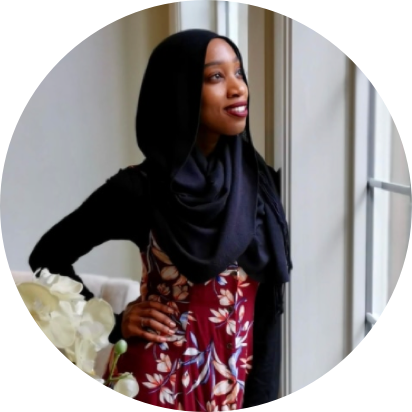
American born, daughter of East African parents. I identify as Black, African-American, and Swahili. My parents were both born in Uganda, my father in Mbarara and my mother in Jinja.
BA Hons in Psychology from Boston University (BU), PhD in Neuroscience from the University of British Columbia (UBC).
I just started a post-doctoral fellowship at the UK Dementia Research Institute (The University of Edinburgh), where I’ll be using in vivo techniques and molecular biology to describe healthy and injured blood vessels within the brain.
I just completed my PhD a few months ago, which focused on traumatic brain injury (TBI), and honed in on the behavioural and neuropathological consequences of head injury.
I just started a post-doctoral fellowship at the UK Dementia Research institute (The University of I’ve always loved STEM, but there were a few stellar individuals, teachers, and professors that encouraged me to pursue a STEM career.
Dr Mae Jemison was one of the early players; my little mind was blown when I saw her photo for the first time. I thought, someone like me has been to space! My teachers in primary and secondary school, though too many to list out by name, were also inspirational.
Dr Peter Bolton, my first-year biology professor from Richmond: the American International University in London, made learning about the human body thrilling, and Dr Paul Lipton, my Neuroscience 101 professor after I transferred to BU, opened my eyes to the universe of the brain and I’ve been in pursuit of learning about the brain ever since.
A general lack of representation – in the 4years I was at UBC, I cannot recall meeting a single person in my program who was also black/African. It sucked. In my lab, there was one other Black girl (though she was in a different program); when she left, I very quickly felt tokenised.
My background has afforded me a vantage point that my peers don’t always have. I think about how our work – which is likely to have clinical implications – affects everyone, not just the affluent and the privileged (who often have better access to healthcare), but also individuals who may not have easy access to healthcare, or trust the healthcare system for valid reasons.
I also like the instant camaraderie that comes out of meeting someone who looks like me (or even remotely like me!) in any social or professional setting. It’s honestly magical.
Visibility is key here! Though we make up a smaller proportion of individuals in STEM, the ones that do exist need to be more well known.
I always say, a whole generation of children dreamed of becoming astronauts only after we made it to the moon. Sometimes you need to see your face represented in spaces in order to dream about the possibility of entering those spaces.
Do you identify as an African in STEM? If so, please send us some basic information to see if we can profile you on the VSA page.
Hello World
I think it’s about time you heard my story.




copyright 2020 | all rights reserved